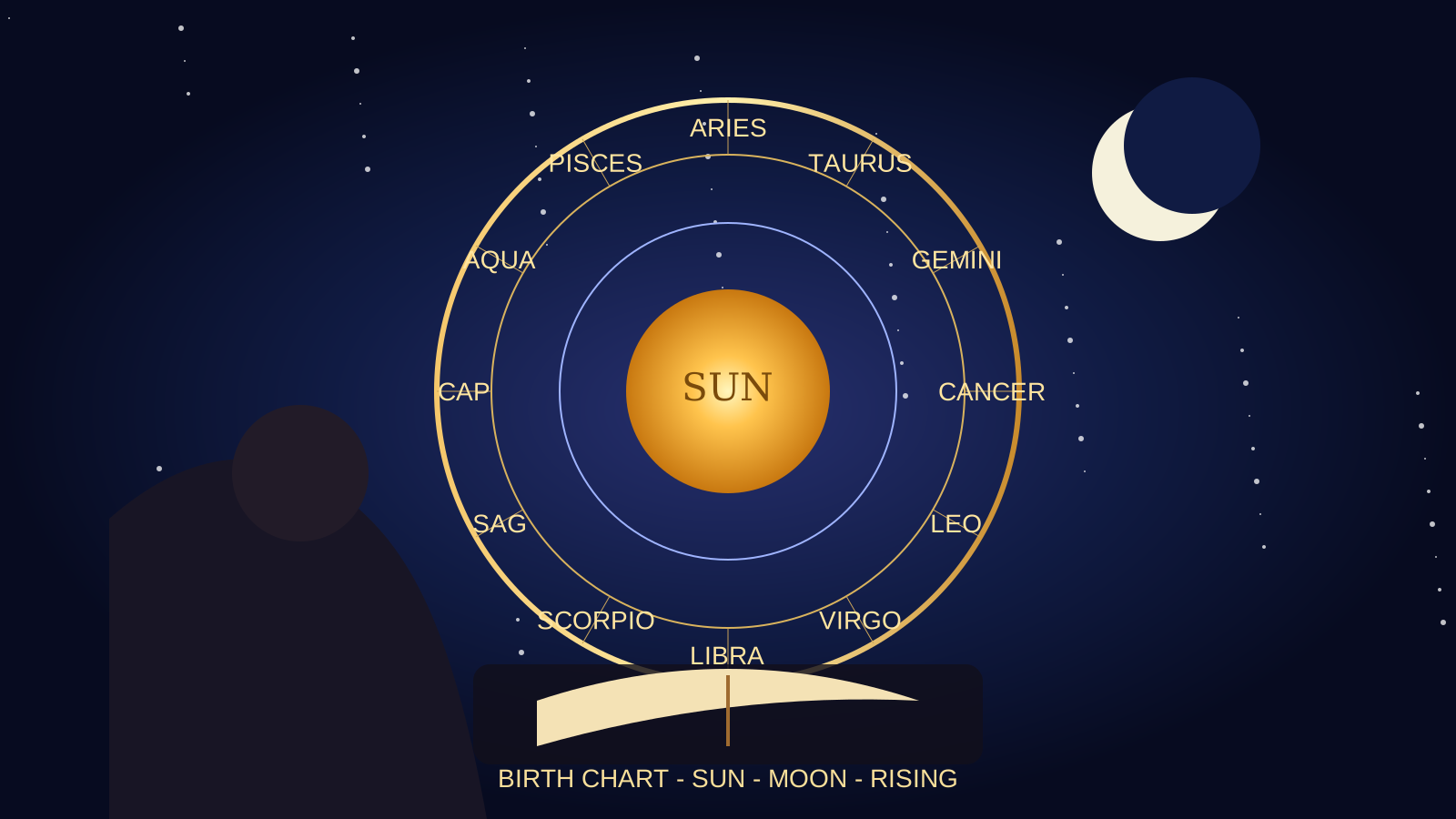
If you have ever looked at an astrology chart and wondered why it seems far more complicated than your Sun sign, a birth chart is the place to start. A natal chart maps the positions of the Sun, Moon and planets at the moment and location of your birth, giving you a more detailed framework for exploring personality, relationships, communication and recurring life themes.
Search demand for “birth chart” is substantial in the U.S., while related searches such as “natal chart,” “birth chart calculator,” “free birth chart” and “rising sign” show strong ongoing interest. That makes birth-chart education a more useful long-term topic than publishing another thin, generic horoscope page.
What Is a Birth Chart?
A birth chart, also called a natal chart, is an astrological snapshot of the sky for your birth date, birth time and birthplace. Astrologers use that information to calculate the zodiac signs and houses occupied by the planets.
The chart is not simply a list of zodiac signs. It combines planets, signs, houses and geometric relationships called aspects. Together, these pieces create the structure astrologers interpret when discussing personality patterns, emotional needs, relationships and personal development.
The Big Three: Sun, Moon and Rising Sign
Sun Sign
Your Sun sign is the part of the chart most people already know. In astrology, it is associated with identity, vitality, purpose and the way a person expresses their central sense of self.
Moon Sign
The Moon sign is traditionally connected with emotions, instincts, comfort and private reactions. Two people with the same Sun sign can feel very different internally because their Moon signs may differ.
Rising Sign
The rising sign, or Ascendant, is the zodiac sign appearing on the eastern horizon at birth. It is commonly interpreted through first impressions, personal presentation and the way someone approaches unfamiliar situations.
Interest in “sun moon rising sign” and related rising-sign searches is currently rising in U.S. keyword data, making this a useful entry point for readers who want to move beyond a basic Sun-sign horoscope.
Why Birth Time Matters
Birth time is especially important for calculating the Ascendant and houses. If the recorded time is inaccurate, parts of the chart can shift. When the exact time is unknown, readers should treat house and rising-sign interpretations with extra caution rather than assuming a precise result.
How to Read a Birth Chart Step by Step
1. Start With the Sun, Moon and Rising Sign
Begin with the Big Three. Ask three simple questions: How do I express myself? What do I need emotionally? How do I naturally meet the world? This gives you a foundation before you move into more technical chart interpretation.
2. Find the Personal Planets
Mercury relates to communication and thinking in traditional astrology. Venus is associated with affection, attraction, values and aesthetics. Mars is traditionally linked with drive, action, desire and how a person handles initiative.
3. Look at the Houses
The twelve houses provide life-area context. The first house is commonly associated with identity and self-presentation; the second with resources and values; the third with communication and learning; the fourth with home and roots; the fifth with creativity and romance; and the sixth with routines and work.
The seventh house is associated with partnerships, the eighth with shared resources and transformation, the ninth with higher learning and worldview, the tenth with career and public life, the eleventh with communities and aspirations, and the twelfth with solitude, reflection and the unconscious in traditional interpretations.
4. Check the Major Aspects
Aspects describe angular relationships between planets. Conjunctions, oppositions, trines, squares and sextiles are among the major aspects astrologers examine. Rather than reading every aspect separately, begin with the strongest repeated patterns.
Birth Chart vs. Horoscope
A horoscope usually provides a general interpretation based on a zodiac sign or a particular astrological period. A birth chart is personalized around birth data and contains substantially more information. That distinction is why searches for “birth chart,” “natal chart” and “birth chart reading” remain important evergreen astrology topics. Current keyword and competitor data also show significant U.S. demand around birth-chart searches.
Birth Chart and Relationships
Astrology readers often compare two birth charts to explore relationship dynamics. This is commonly called synastry or birth-chart compatibility. The focus can include Venus and Mars, the Moon, the seventh house and major aspects between two people’s charts.
Compatibility should be approached as an interpretive astrology framework rather than a scientific test of whether a relationship will succeed. It can be used as a reflection tool for discussing preferences, communication styles and expectations.
Birth Chart and Career Themes
Career-oriented chart interpretation often looks at the tenth house, its ruling planet, the Midheaven and relevant planetary placements. Some astrologers also examine Saturn, Jupiter and Mars when discussing discipline, expansion and motivation.
Rather than asking a chart to provide one fixed career answer, a more useful approach is to identify recurring themes and compare them with real-world interests, skills and opportunities.
Common Birth Chart Mistakes
- Reading only the Sun sign: the Sun is important, but it is only one part of the chart.
- Ignoring birth time: the Ascendant and houses depend heavily on accurate timing.
- Treating one placement as destiny: a complete chart contains many interacting factors.
- Overusing generic keywords: astrology content is more useful when it explains concepts clearly instead of repeating sign names.
- Confusing interpretation with certainty: astrology is a belief and interpretive system, not an established scientific method.
Frequently Asked Questions About Birth Charts
What is the most important part of a birth chart?
There is no single universally “most important” placement. Many beginner readings start with the Sun, Moon and Rising sign, then expand into planets, houses and aspects.
Can I read my birth chart without knowing my exact birth time?
You can still examine some planetary placements, but an unknown or inaccurate birth time can make the Ascendant and house positions uncertain.
Is a natal chart the same as a birth chart?
Yes. “Natal chart” and “birth chart” are commonly used for the same basic astrological chart calculated from birth information.
Can a birth chart predict the future?
Astrologers may use charts to discuss cycles and symbolic themes, but astrology should not be treated as a scientifically validated method for predicting specific future events.
Explore More Astrology Insights
If you are learning how current planetary symbolism fits into a larger chart, explore our guides on Mercury in Scorpio, Libra Season, the October 2026 monthly horoscope, and the Hunter’s Moon in Taurus.
For a general background reference, see Wikipedia’s overview of astrology.