
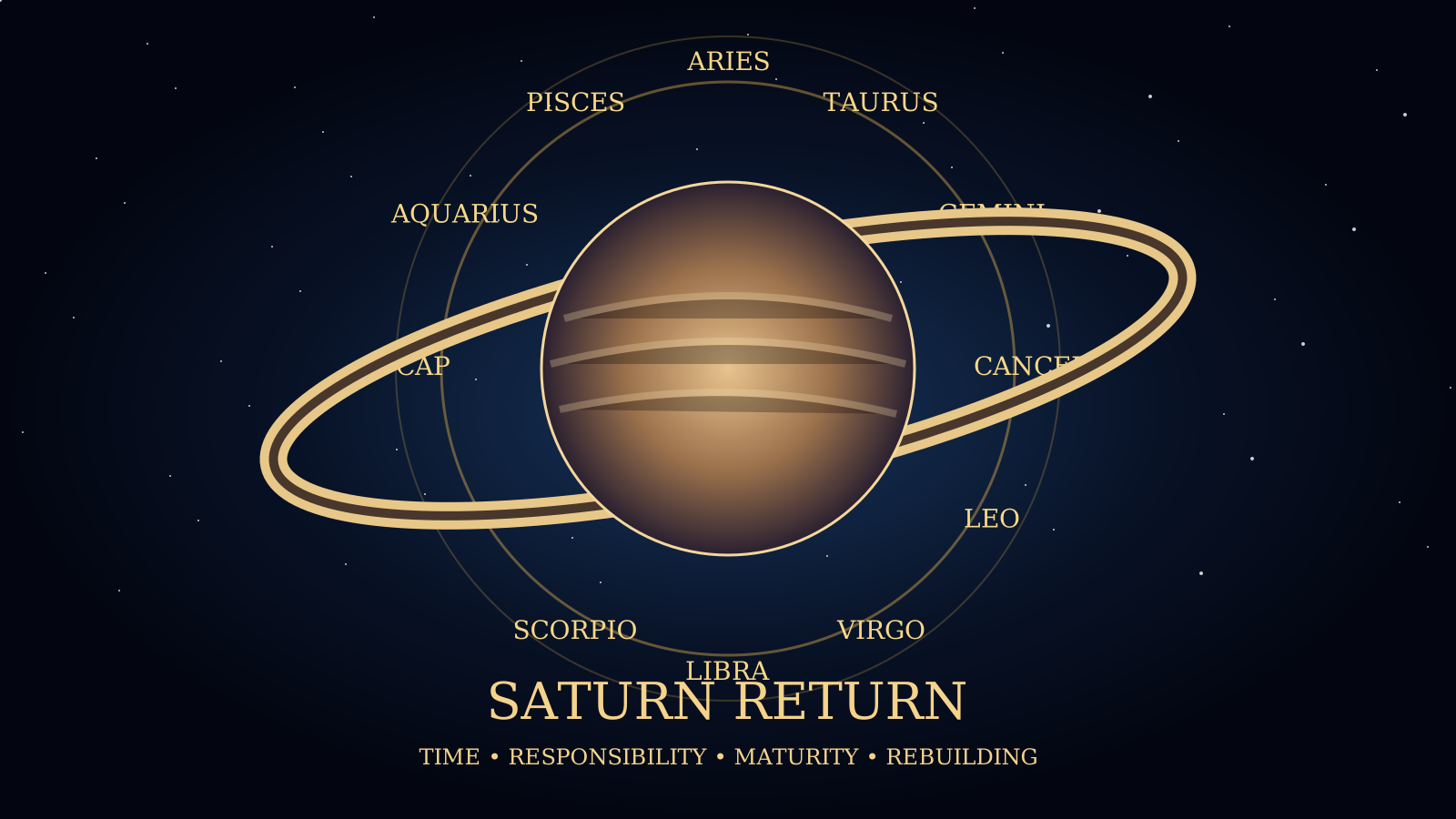
Saturn return is one of the most talked-about milestones in astrology, especially for people approaching their late twenties. It has a reputation for bringing major decisions about career, relationships, money, home and identity. But the popular idea that a Saturn return automatically means your life will fall apart is much too simplistic.
In astrology, a Saturn return happens when transiting Saturn comes back to the zodiac position it occupied at your birth. Because Saturn takes roughly 29.5 years to travel around the zodiac, the first return commonly occurs around the late twenties. A second return generally arrives around the late fifties, followed by a third around the late eighties.
The more useful way to understand this cycle is as a period of review, responsibility and structural growth. Astrology does not scientifically establish that Saturn causes life events, so the ideas in this guide should be treated as an astrological framework for reflection rather than a guaranteed prediction.
What Is a Saturn Return?
A Saturn return is a planetary return in a birth chart. Your natal chart records where the planets were positioned when you were born. During a Saturn return, Saturn travels through the zodiac until it reaches the same sign and, more importantly, the same degree as your natal Saturn.
That exact degree matters. Saying someone is having a Saturn return simply because Saturn is in the same sign is a useful shortcut, but a detailed reading looks at the precise natal position and the houses involved.
Saturn is traditionally associated with responsibility, boundaries, time, discipline, commitment, authority and long-term construction. This is why astrologers often connect a Saturn return with questions such as:
- What am I actually building?
- Which commitments are sustainable?
- Where have I been avoiding responsibility?
- What needs stronger boundaries?
- Which goals are worth years of effort?
Why Does the Saturn Return Happen Around Age 29?
Saturn takes approximately 29.5 years to complete an orbit around the Sun. In astrology, that long cycle becomes a symbolic clock for major stages of development.
The first Saturn return therefore tends to occur somewhere around the late twenties or early thirties. The exact timing varies from person to person because natal Saturn can be located at any degree of its sign, and Saturn’s apparent motion can include retrograde periods.
This is also why two people who are the same age may not experience their Saturn return at exactly the same time.
What Does a Saturn Return Mean?
Astrologers often interpret Saturn return as a maturity checkpoint. It can bring greater awareness of the difference between what looks good temporarily and what can actually support your life over many years.
For one person, that may mean becoming more serious about a career. For another, it could involve leaving a relationship that no longer reflects their values. Someone else may decide to relocate, buy a home, return to school, start a business or create firmer financial boundaries.
The important point is that a Saturn return does not prescribe one universal event. The natal Saturn sign, natal house and aspects to Saturn help determine the themes astrologers emphasize.
Saturn Return and Career
Career is one of the areas most frequently associated with the first Saturn return. People may begin questioning whether their professional life is sustainable, meaningful or aligned with the person they are becoming.
Typical themes can include taking on leadership, accepting greater responsibility, changing industries, developing a serious skill, establishing a business structure or realizing that a particular career path is not worth continuing.
A Saturn return is not necessarily about achieving a prestigious job title. It is more about building something durable. A slower but sustainable career path may fit Saturn symbolism better than a quick success that cannot be maintained.
Saturn Return and Relationships
Relationships can also become more serious during a Saturn return. This does not automatically mean marriage, separation or a breakup. Instead, astrologers often view the period as a test of structure and commitment.
Questions may include whether two people share compatible long-term goals, whether responsibilities are balanced, whether boundaries are respected and whether the relationship can adapt as both people mature.
Some relationships become stronger because both partners are willing to grow. Others may feel increasingly difficult when the foundation is weak.
Saturn Return and Money
Financial responsibility can become more visible during this cycle. People may become less interested in short-term spending and more focused on savings, debt, investing, insurance, housing or building reliable income.
Astrology cannot guarantee financial outcomes, but the Saturn symbolism of limits and long-term planning can be used as a useful reflection prompt: What financial structure would make my future self feel safer?
Saturn Return by Zodiac Sign
Saturn in Aries
Saturn in Aries can emphasize independence, self-leadership and learning how to act with patience instead of relying only on impulse. The growth challenge may involve developing confidence through consistent action.
Saturn in Taurus
This placement can focus attention on stability, money, possessions, values and patience. The lesson is often about building security without becoming trapped by fear of change.
Saturn in Gemini
Communication, education, information and decision-making can become important themes. The person may need to become more disciplined about learning, speaking and managing mental distractions.
Saturn in Cancer
Home, family, emotional boundaries and security may become central. Maturity can involve creating a healthier definition of emotional responsibility.
Saturn in Leo
Self-expression, creativity, confidence and recognition can be tested. The goal is not to stop shining but to develop confidence that does not depend entirely on outside approval.
Saturn in Virgo
Work habits, health routines, organization and perfectionism may receive attention. The constructive lesson is learning how to create useful systems without demanding impossible perfection.
Saturn in Libra
Partnership, fairness, contracts and boundaries may become major themes. Saturn here can encourage more mature approaches to cooperation and commitment.
Saturn in Scorpio
Trust, intimacy, shared resources and emotional control may come under review. The deeper work can involve learning when to hold on, when to let go and how to handle vulnerability responsibly.
Saturn in Sagittarius
Beliefs, higher education, travel and long-term vision can be reconsidered. The challenge may be turning broad ideas into a practical philosophy that can actually guide daily life.
Saturn in Capricorn
Ambition, authority, career and achievement are especially prominent Saturn themes here. The return can encourage a more mature definition of success and a stronger relationship with responsibility.
Saturn in Aquarius
Community, technology, networks and individuality can become important. The growth lesson may involve balancing personal freedom with meaningful contribution to a larger group.
Saturn in Pisces
Boundaries, faith, compassion, imagination and emotional sensitivity may become central. Saturn can encourage turning dreams into practical structures while learning that healthy boundaries do not eliminate empathy.
Saturn Return Through the Houses
The sign of natal Saturn describes the style of the lesson, while the house shows the life area where astrologers expect the process to be most visible.
- 1st house: identity, independence and personal direction.
- 2nd house: money, possessions, self-worth and values.
- 3rd house: communication, learning and local environment.
- 4th house: home, family and emotional foundations.
- 5th house: creativity, romance, children and self-expression.
- 6th house: work routines, service and daily habits.
- 7th house: partnerships, marriage and one-to-one commitments.
- 8th house: intimacy, shared finances and transformation.
- 9th house: education, beliefs, travel and worldview.
- 10th house: career, reputation and public responsibility.
- 11th house: friendships, communities and long-term goals.
- 12th house: solitude, closure, inner work and unconscious patterns.
How to Find Your Saturn Return
Start with your birth chart and locate Saturn. You need your birth date, birth location and, ideally, an accurate birth time for a complete chart interpretation. Our birth chart guide explains the main pieces of a natal chart, while the free birth chart calculator can help you explore your placements.
Once you know your natal Saturn sign and degree, compare it with Saturn’s current and future positions. A detailed Saturn return may involve more than one exact pass because retrograde motion can cause Saturn to cross the same degree multiple times.
Saturn Return Is Not a Guaranteed Crisis
One of the biggest problems with online Saturn return content is fear-based language. You may see claims that everyone loses a relationship, changes careers or experiences a major crisis at 29. That is not a reliable way to interpret astrology.
Saturn symbolism is better understood through responsibility and structure. A person with a stable life may experience the return as a period of consolidation rather than destruction. Someone with unstable foundations may feel stronger pressure to make changes.
The chart provides the symbolic framework; real-life circumstances, choices and social conditions still matter.
Saturn Return vs. Saturn Transit
Every Saturn return is a Saturn transit, but not every Saturn transit is a Saturn return. A transit describes Saturn moving through a particular part of your chart. A return specifically means Saturn has come back to its natal position.
That distinction matters because Saturn can activate different houses and planets throughout life. The return is especially notable because it closes and begins a major Saturn cycle.
What to Do During a Saturn Return
If you believe you are approaching this milestone, focus on practical questions instead of trying to predict disaster.
- Review your long-term career direction.
- Build a realistic financial plan.
- Strengthen boundaries in relationships.
- Finish responsibilities you have repeatedly postponed.
- Invest in skills that remain useful over time.
- Reduce commitments that no longer fit your values.
- Create routines that support your physical and emotional energy.
- Give important decisions enough time to mature.
Saturn is traditionally associated with patience, so the most useful response is rarely panic. It is usually steady construction.
Frequently Asked Questions About Saturn Return
What age is the Saturn return?
The first Saturn return commonly occurs around ages 27 to 31, with the exact timing depending on the natal Saturn position and Saturn’s motion.
Does everyone have a Saturn return?
Yes, in the astrological sense, everyone whose birth chart includes Saturn will eventually experience Saturn returning to its natal position. The timing depends on the birth chart.
Is Saturn return always bad?
No. Astrology does not require the Saturn return to be negative. It is often interpreted as a period of maturity, responsibility, restructuring and long-term decision-making.
How long does a Saturn return last?
The exact return is a moment when Saturn reaches the natal degree, but astrologers often interpret a wider window around it. Retrograde motion can create multiple exact contacts over an extended period.
Can Saturn return affect relationships?
It can be interpreted as a period when relationship commitments and boundaries become more important, particularly when Saturn strongly activates the relationship houses or planets connected with partnership.
What is a second Saturn return?
The second Saturn return happens roughly 29.5 years after the first, commonly around the late fifties. Astrologers often associate it with legacy, responsibility, aging, purpose and the structures a person wants to carry forward.
Final Takeaway
A Saturn return is less useful as a prediction of catastrophe than as a symbolic invitation to grow up on your own terms. It can highlight the difference between temporary choices and sustainable commitments, between external expectations and personal responsibility, and between a dream and the structure required to build it.
If you are exploring your chart, combine Saturn’s sign and house with the rest of your natal placements rather than reading the return in isolation. You can also explore our synastry chart guide if relationship astrology is part of your current questions, or return to our monthly horoscope guide for broader current astrology themes.
For a general reference on the astrological concept, see Saturn return on Wikipedia.